2,000 kilometers away, one Qimen chart, three decisions that mattered.
This is a personal story, not medical advice. Qimen does not diagnose or treat illness. In this case the chart helped with decisions: how seriously to take the situation, which information to trust, which direction to seek care, while doctors made the actual diagnosis. If you or a loved one are unwell, please see a qualified medical professional without delay.
My mother passed away seven years ago. My father is my only family left. Worried he had no one to look after him on his own, I tried to keep him with me in the south as much as I could throughout the year. But recently something back home needed handling, and he went back alone.
The day after he arrived he took a bath; the day after that he collapsed. He ran a fever for days, too weak to even go out and buy medicine. Then the worst part: his face began to swell, spreading from one cheek to the other and down into his neck, until he barely looked like himself. And he hid all of it from me for nearly a week before saying a word. On June 16 I got his message: he wasn't doing well. My anxiety instantly soared, because any shift in his health has always felt enormous to me. Nearly 2,000 kilometers away, I wanted nothing more than to teleport myself there. The only thing I could do from where I stood was sit down, steady myself, cast a chart, see clearly what I was really dealing with, and figure out how to handle the next few days.
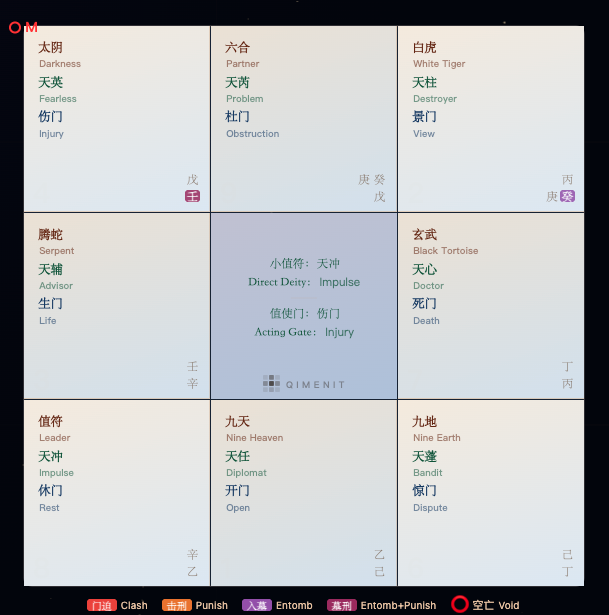
A health question isn't read from a single palace. It has a cast of used-gods, and the reading is how they relate. Here the key ones were: the illness itself (天芮, the Illness Star); my father (the male-elder stem 丙); Western medicine (天心, the Doctor Star); the direction to seek care (the Yi 乙 "wonder" stem); and recovery (the Life Door 生门). Before judging anything, I had to find where each one sat.
The Illness Star (天芮) sat in Palace 9 (Li/离, South), on the outer plate. Li governs the head and face, the eyes, the heart and the blood vessels; on the outer plate it points to something external and visible. That matched his swollen face exactly. Paired with the stem Geng it read as a heavy, serious signal, with Obstruction Door suggesting blockage. In plain terms the chart was telling me: this is on the head and face, it is external, and it is not minor.
I couldn't tell what disease it was, but I could read severity and location, and that alone mattered, because my father wanted to brush the whole thing off as nothing.
The palace standing for Western medicine (天心, the Doctor Star) carried Black Tortoise (玄武) plus the Death Door (死门). Black Tortoise is the deity of murky, unreliable information; the chart's note was blunt: verify the truth of any medical information you're given. That line was proven the very next day.
Right next to his hometown stood a local hospital, extremely convenient by distance, but its equipment was only adequate and I didn't trust the doctors' judgment in the slightest. Still, my father insisted on going. From afar I could only agree to let him get basic blood work there while I decided the real direction. Sure enough, the next day that hospital diagnosed "allergic dermatitis," ran a battery of allergen tests, prescribed topical ointment, and sent him home. He was ready to treat it as nothing serious and told me not to rush back. I refused. The chart had already warned me not to trust the information, so I treated that label as a question, not an answer.
My first instinct was to bring him back south to the city where I live, where medical resources and transport are far better. But that direction on the chart carried the White Tiger (白虎) and the Destroyer Star (天柱), clear malefic signals. Obviously not the right move.
Fortunately the chart did point to one clearly favorable direction: due north (Kan Palace 1/坎一宫): the Yi 乙 wonder stem together with the Open Door (开门) and Nine Heaven (九天), no malefics, and Kan is water, which directly restrains the fire-illness sitting in the South. Going north meant going toward the force that could hold the illness in check. Due north of his hometown is the provincial capital. The signal was clear enough. I booked a flight immediately, flew straight there, and told him to meet me.
Three decisions, all from the chart: take it seriously (a heavy illness star on the head and face), don't blindly trust a diagnosis (murky information on the medicine palace), and go north (the one direction that restrained the illness and carried no malefics). The chart didn't diagnose anything, the doctors would do that. What it did was make the calls I was too anxious, and nearly 2,000 kilometers away, to make with any confidence on my own.
I landed in the provincial capital, met my father, and took him straight to the emergency department of its top general hospital. We didn't even know which specialty to book, and there was no time to book online anyway. The ER doctor was overwhelmed and couldn't pin it down, but pointed us toward a specialist skin hospital. I was skeptical: the hometown hospital had already sent us to dermatology and called it "allergic dermatitis." Go to dermatology again? But the skin hospital was close, so we went.
There, the doctor took one look and said it plainly: erysipelas (丹毒), an acute bacterial skin infection. I had actually suspected it earlier and dropped the idea because my father kept saying it didn't hurt. This time the doctor pressed the swelling; my father admitted it hurt under pressure, and the diagnosis clicked into place. The treatment was a course of IV antibiotics.
The rest was logistics. My father refused to be admitted for a week away from home; another general hospital's infection department turned us away and said to see dermatology; the skin hospital would only treat via full inpatient admission, which he wouldn't accept. So we went back to the hometown, to the very hospital I'd distrusted. But it no longer mattered: with the correct diagnosis and treatment plan in hand, the rest was simple. A week of cephalosporin IV there, and he was essentially back to health. The chart's value was never the treatment location. It was refusing the wrong diagnosis and going where the right one could be found.
I won't pretend the chart was flawless, it wasn't, and saying so matters more to me than looking impressive. It also warned that Western treatment would go poorly, that recovery would be tortuous, with relapses, even "false hope." None of that has matched what I've seen so far, and it planted a seed of unease I still carry: was one week of antibiotics only a temporary reprieve?
But in that first critical stretch it pointed me to the decisions that actually mattered: intervene actively, don't blindly trust the local hospital, go north to get the right diagnosis. When I was too frightened to think clearly, it gave me a structure I could lean on and kept a bad situation from getting worse. For a daughter nearly 2,000 kilometers away, wanting to help but unable to be there, the outcome we have now is enough to put my mind at ease.
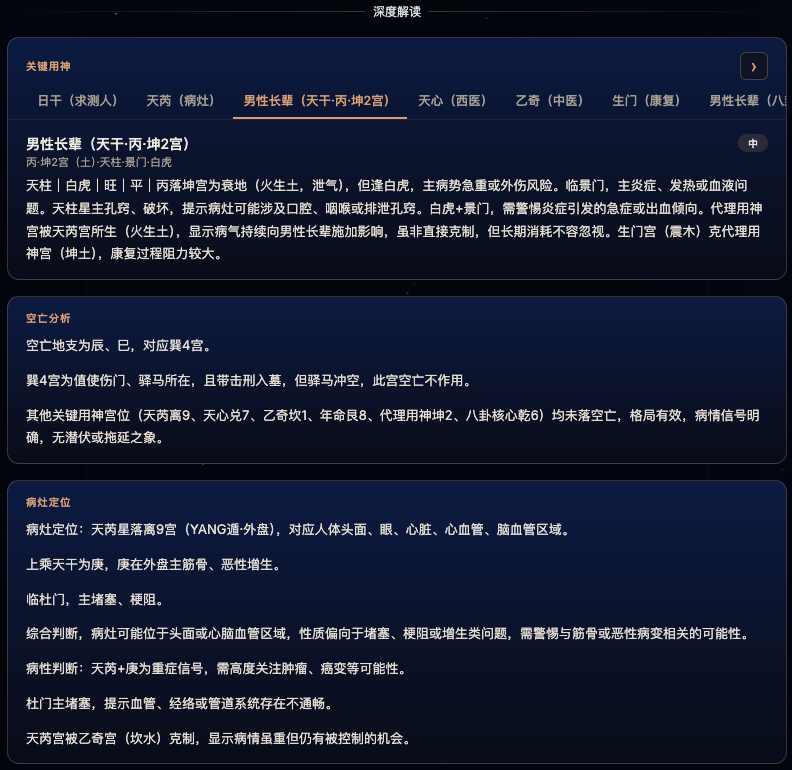
This case was cast and read entirely on QimenIt, in Health mode, the screenshot is the actual reading I acted on that afternoon, not a later reconstruction.
It laid out each used-god on its own tab: the Illness Star (天芮) located on the head and face; the male-elder palace under the White Tiger; the Western-medicine palace flagged for unreliable information; and the void analysis confirming the signals were clear, not delayed.
The reading gave me structure to think with when I was too frightened to think clearly. It didn't decide for me, it showed me what the moment contained, and I made the calls.
Facing a hard decision and no one to think it through with?
Get your own reading →