Career · Workplace

A New Job, and a Chart Asking How It Would Go

This job of mine — how will the road ahead go?

April 2026 · verified by what happened
Background

April 2026. A friend left the city he knew and moved for a new job, and cast a chart on it for that reason, simply to see: this job of mine, how will the road ahead go?

April 2026
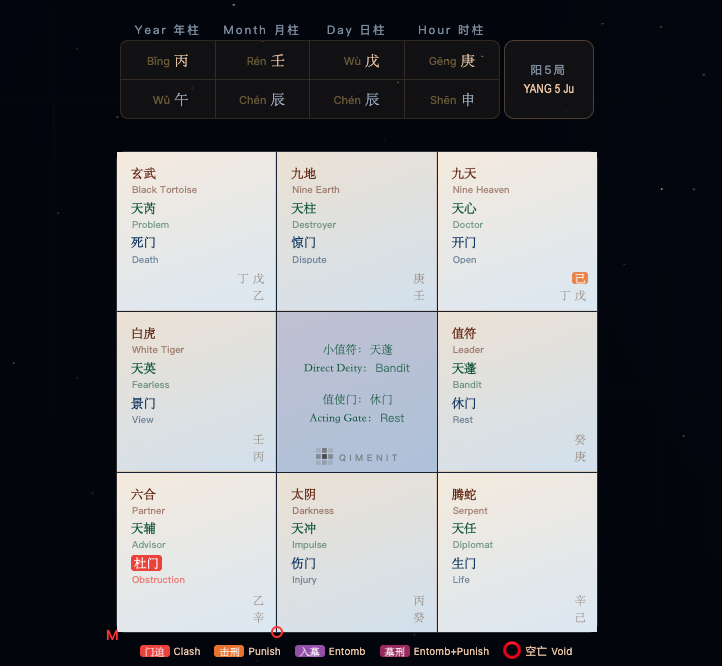
The QimenIt chart cast in April 2026, asking about the road ahead in his job
Step 1: Who's Who in a Career Chart

A career question isn't read from one palace. It has a cast: him (the day stem 戊); the matter itself (the hour stem); the boss above him (值符, the Chief Star); the job and the role (the Open Door 开门); and what it pays him (the Life Door 生门). The reading is what happens between them.

Start with where they landed. He and his colleagues sat on the inner plate, close in. The job, the matter, his boss, the money all sat on the outer plate. In plain terms: the forces deciding his career were outside him, not in his hands.

Step 2: Read the Pressure

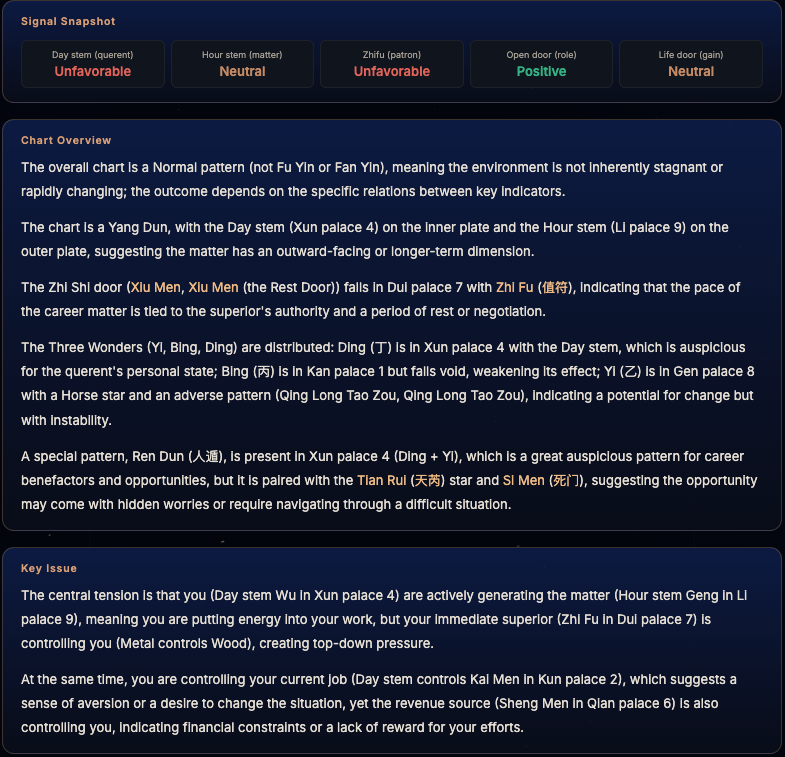
The reading named the core contradiction outright: "He has the ability, and he has the will to actively seek change. But he is held down by the boss directly above him, and at the same time what the job returns to him runs against his own state, so effort and reward are out of proportion, and the internal drain is heavy."

Two palaces, two directions. Neither is a disaster on its own; together they make a very specific kind of workplace, the kind where you're capable, you're willing, and none of it converts.

Step 3: Read the Role Itself

Of the five key indicators, two came back unfavourable: his own state, and the patron above his. Two were neutral. One came back improving: the role itself.

So the chart wasn't saying the job was worthless. It was saying the job was fine and his position inside it was not, which is a different diagnosis pointing at a different exit.

Step 4: Read Where the Turn Sits

Of the three "wonder" stems, Ding fell into his own palace, forming a favourable structure the reading called "his single greatest turning point." Not the boss's palace, not the money palace. The turn was sitting in the same square he was.

Which is why the headline verdict came out the way it did: "There is resistance in the career, and it needs an active breakthrough. The situation right now leans toward suppression, but he has both the will and the energy to adjust it himself."

What the Chart Actually Said

Strip it to one line and the chart said this: the pressure on you is real and it comes from above you; the job itself isn't the problem, your position in it is; and the thing that moves this is you, not them. No instruction to quit. No date. Just a clear picture of what he was standing in, and where the one piece of leverage sat.
He looked at the chart, saw the pressure on it, and then got on with his life.

He didn't dismiss it or argue with it. He just didn't take it as being about him, this month, in this chair. Knowing full well there were tigers on the mountain, he went up the mountain anyway. Which is what most people do with most charts.

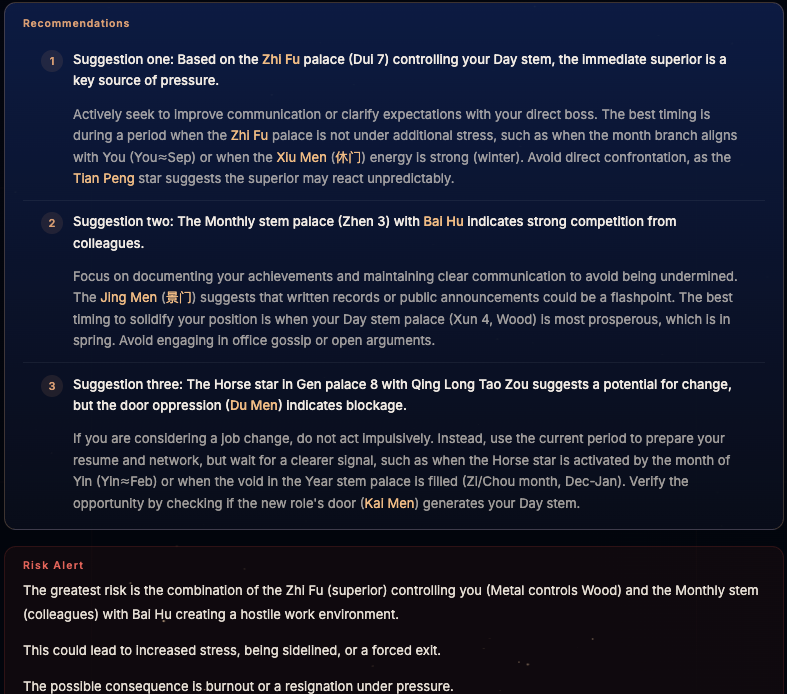
And the chart had already written down where the road ended. From the risk alert: "The greatest risk is the combination of the Zhi Fu (superior) controlling you and the Monthly stem (colleagues) with Bai Hu creating a hostile work environment. This could lead to increased stress, being sidelined, or a forced exit. The possible consequence is burnout or a resignation under pressure."

Two months later, he was gone. Then he did the part most people skip: he went back to the chart with the outcome in hand and said, under his own name, that it had been right.

The Hard Part Isn't Reading It

It never told him to quit. A chart that says "resign" is doing something it has no business doing. This one did something narrower: it told him where the pressure came from, that the job itself wasn't the problem, and that the leverage was his.

He understood all of that in April. Understanding it was never the hard part. The hard part is believing it's about you, now, in the chair you're sitting in. He didn't get there in April. Two months later his life got there for him.

That's not the same as saying you should do whatever a chart says. The decision stays yours; it always was. It's that when something lays your situation out in front of you, the easiest thing in the world is to set it aside. Setting it aside has a price. His was two months.

The Reading, Unedited
QimenIt career reading for the April 2026 chart: signal snapshot, chart overview and key issue
The verdict, the signal row, and the key issue.
QimenIt career reading for the April 2026 chart: recommendations and risk alert
The recommendations, and the risk alert that named the exit.

Facing a hard decision and no one to think it through with?

Get your own reading →