Buying a place to live in and buying one to profit from are two different readings, and the first thing we settle is which one you are asking. For a home you will live in, the main line is the relation between you (Day Stem) and the dwelling (Hour Stem): a house that generates you is favourable, one that controls you is not, whatever else the chart shows. For a purchase made to profit, the line moves to Chief Star (the party trading) against Life Door and Death Door (the dwelling and the land), with Jiazi-Wu for the money. And Life Door answers a different question from Hour Stem: Life Door is the property's lasting quality, Hour Stem its condition now. A place that shows well today can still read poorly for the long run. Whichever of the two you are asking, the verdict lands on one of three readings — go, wait, or stop — rather than on a bare yes or no.
Before the rules, one real chart. May 2023, a quarter past eight in the evening: after ten hours of house-hunting, a salesman was pressing for a ¥100,000 deposit on the spot. A chart cast right there showed warning signals stacked against the deal, and the buyer walked away. One week later, the local market slid. Read the full case →
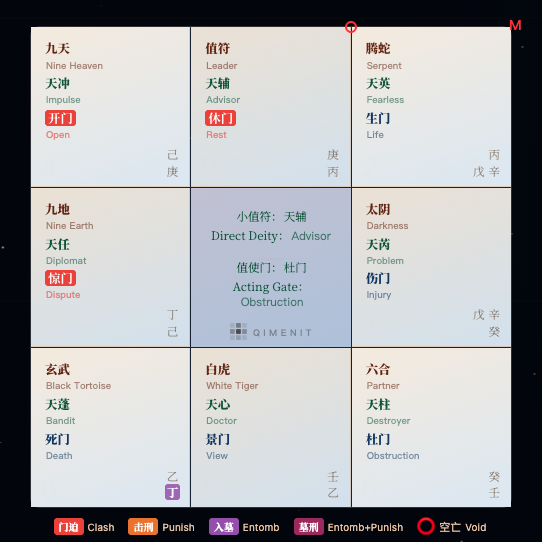
Person and Dwelling: the Line Everything Hangs On
Qimen takes the Day Stem as the person and the Hour Stem as the dwelling: where the two generate each other the place is favourable, and where the dwelling controls the person it is not fit to live in. That single line carries the whole of a home reading, and every section below is an unfolding of it.
Unfold it and a ranking appears. A dwelling that generates the person is the best case, a house that feeds the person living in it. The same element between the two comes next, an even fit with no friction. The person controlling the dwelling is still liveable: you hold the place down rather than the reverse. The person generating the dwelling drains you, tolerable for a while and poor for the long term. And a dwelling that controls the person is the one case refused outright, because a dwelling that works against its occupant stays unfavourable no matter how good the rest of the chart looks.
This is also why a chart can turn down a place you have already fallen for. The method does not rank houses by how good they are; it ranks them by how they treat you. A dwelling that suits one person can read poorly for the next.
Who's Who in a Property Chart
The set shifts with what you intend to do. Living in the place puts you and the dwelling at the centre. Buying to profit moves the centre to the traders and the money.
| Symbol | What it stands for here |
|---|---|
| 日干Day Stem | You: the buyer, or the person who will live there. |
| 时干Hour Stem | The dwelling as it stands now: its present condition and its aspect. |
| 生门Life Door | The dwelling's lasting quality. The long-run information, as against Hour Stem's present one. |
| 死门Death Door | The land itself: the plot and the ground it sits on. |
| 值符 / 值使Zhi Fu / Zhi Shi | The parties trading, and the wider setting. Which one is which follows the scenario: in a sale, Chief Star is you the seller and Chief Door the buyer; in a purchase made to profit, Chief Star is the party buying. |
| 甲子戊Jiazi Wu | The money: your capital and funding. |
| 年命Natal Year Stem | You in the lasting sense, and by extension the bedroom. |
Buying a Place to Live In
For a home you intend to live in, the rule from the first section becomes a five-step ranking. Read your Day Stem against the Hour Stem and the answer sits in one of these rows. (If the purchase comes bundled with leaving your city altogether, settle the movement question first: Should I Relocate?)
| Person and dwelling | How it reads |
|---|---|
| Hour Stem generates Day Stem (宅生人) | ✓✓ A favourable dwelling: the house feeds the person living in it |
| Day Stem and Hour Stem in the same element (same-element) | ✓ An even fit: settled, no friction either way |
| Day Stem controls Hour Stem (人镇宅) | ◐ Liveable: you hold the place down rather than the reverse |
| Day Stem generates Hour Stem (人泄宅气) | ◐ It drains you: tolerable for a spell, poor to settle in for years |
| Hour Stem controls Day Stem (宅伤人) | ✕✕ The one case refused outright, and a good pattern elsewhere does not redeem it |
Three placements sharpen the last row rather than soften it. Hour Stem with Black Tortoise or Bandit Star controlling your Day Stem points to theft; with Illness Star controlling it, to illness in the household; with Death Door and White Tiger in a poor pattern striking your palace, to something larger. These are the cases where we would rather you walked away from a place you liked than talked yourself into it.
Whether the dwelling suits you and whether the purchase actually closes are two separate readings, and a chart can answer the first favourably while the second stalls. The signals below speak to the transaction itself.
- Either Day Stem or Hour Stem on Void: one side isn't really there
- Day Stem and Hour Stem in clashing palaces (对冲之宫): it doesn't come together
- Hour Stem in a clash pattern (逢冲格): hard to close
- A party with Black Tortoise or Serpent: that side changes its mind; what they say won't stand
- Day Stem entombed (Entombment): low odds of it working out for you
- Either party on Six-Instrument Punishment Clash: something goes wrong along the way
Buying to Profit, and Selling
Once the point of the purchase is money rather than living there, the centre of the chart moves. Chief Star stands for the party trading, Life Door for the dwelling, Death Door for the land, and Jiazi-Wu for your capital. The question is no longer whether the house suits you; it is which side of the deal the chart favours. Read this way, a property is simply a stake, and the capital-versus-return test behind every stake is worked through in Is This Investment Worth the Risk?
| Pattern in the chart | How it reads |
|---|---|
| Life Door / Death Door with Three Wonders and a good pattern, generating Chief Star | ✓✓ The most favourable reading in this set: the property works in the buyer's favour after the purchase |
| Life Door / Death Door generating Chief Star but without a good pattern | ◐ Favours the seller instead: they are the one who does well out of it |
| Life Door / Death Door in the same element as Chief Star | ✓ Safe: holds its value rather than climbing |
| Life Door / Death Door weak and lifeless, with an ill pattern striking Chief Star | ✕✕ Ruinous after the purchase: the property takes the household down with it |
| Chief Star generating Life Door / Death Door in return | ✕ You feed the property: it declines you rather than the other way round |
The roles swap: Chief Star is you, the seller; Chief Door is the buyer; Life Door is the house. You can also read the transaction straight from the stems: Day Stem generating Hour Stem favours the seller, Hour Stem generating Day Stem favours the buyer, and where Day Stem controls Hour Stem the buyer walks away. Which side the chart leans toward is the thing to establish before you set a price.
A chart reads the shape of a decision: whether the dwelling suits the person, which side the transaction leans toward, and which signals stop it. It does not value a property, name a price, or forecast a market, and nothing here should be taken as property or investment advice. What you buy, whether you sell, and at what number, stays yours to decide.
Frequently Asked Questions
The house is objectively good. Why does the chart say no?
Because the reading ranks a dwelling by how it treats you, rather than by how good it is. The rule is explicit: where the dwelling harms the person (时干克日干), it should not be lived in, and a fine pattern elsewhere in the chart does not overturn that. The same property can read favourably for one buyer and poorly for the next, which is why a chart answers “is this house right for me” rather than “is this a good house.”
What's the difference between Life Door and Hour Stem for a house?
Hour Stem is the dwelling now; Life Door is the dwelling over the years. The pair is worth separating because they routinely disagree. Good Hour Stem with poor Life Door is the flat that shows beautifully at the viewing and wears badly afterwards. Poor Hour Stem with a strong Life Door is the opposite: rough condition on sound bones, worth improving rather than passing on. Death Door, the land beneath it, is the part no renovation reaches.
Does buying to live in and buying to profit use the same chart?
The same chart, a different set of symbols. Living there puts you (Day Stem) against the dwelling (Hour Stem), and the person-and-dwelling relation decides it. Buying to profit moves the centre to Chief Star for the party trading, Life Door and Death Door for the dwelling and the land, and Jiazi-Wu for the capital; the question becomes which side of the deal the chart favours. Asking the wrong one of the two is how people end up with a sound investment they are unhappy living in.
I want to sell. Which side does the chart favour?
Read it from the stems. The rule is plain: Day Stem generating Hour Stem favours the seller; Hour Stem generating Day Stem favours the buyer; where Day Stem controls Hour Stem, the buyer walks away. As the seller you are Chief Star and the house is Life Door, and where the house sits poorly the reading is that the deal is not leaning your way. That is the thing to weigh before you settle on a number, rather than after.
Wondering why a traditional system is being used to weigh a decision at all? That question is taken up separately in divination for decision making, which covers what each of these systems is suited to and where the category has to stop.
If this is the decision on your table tonight, choose Decision-making · Act or hold and cast a free chart. The verdict comes back as go, wait, or stop — with the reasons, each signal explained in plain language. See what a full reading looks like →
Cast a Free Chart →