How QimenIt Analyzes a Question
QimenIt is not a personality test, and it is not general life advice. Every analysis starts from one specific question. You choose the question you want analyzed; the system casts the chart for that moment, extracts the structures that bear on it, and turns them into an account of the situation you can actually follow.
The phase you are in, and the tempo and direction the matter is moving in.
The external environment, the resources at hand, and the ground you are standing on.
The people involved, how they interact, and where the weight of support or resistance sits.
The factors that resist measurement but still move things — unlooked-for help, and shifts you could not have planned for.
For questions about whether to move forward, the analysis gives a directional leaning: favorable to act, better to wait, or better to hold off. That leaning is not a decision made on your behalf — it tells you which way the situation currently tilts, which factors deserve the most weight, and what to watch for as you act.
What a Specific Question Can Reveal
QimenIt is not concerned with an abstract “life fortune”. It is concerned with the one real matter in front of you. Every signal the chart throws carries a verdict; here are six, taken from the questions people bring most often:
The left-hand column is handled for you. You do not need to learn Qimen Dunjia, or interpret a single symbol yourself.
Why This Kind of Analysis Is Worth Having
In consequential decisions, information alone does not reliably produce an answer. The same set of facts, in different hands, at a different stage, in a different environment, can lead somewhere else entirely.
Qimen Dunjia is a traditional Chinese system that examines the relationship between a person, a moment, and the conditions surrounding them. What it has always looked at is not one isolated factor, but how those three sit together. The questions have changed shape over the centuries: “when do we attack” has become “when do I sign, launch, negotiate, move.” Underneath, it is the same question. Where it comes from →
QimenIt turns that traditional method into a modern pipeline: cast the chart for the question at hand, extract the governing structures by fixed rules, then render what the chart holds into an analysis you can act on. The chart is not the decision. The point of the analysis is to let you look at the same problem from somewhere else.
What an Analysis Actually Looks Like
The case below is not here to demonstrate accuracy. It is here to show two things: what an analysis actually looks like, and what it does not do. In April 2026, a friend had just left a city he knew well to start a new job. He cast one chart, and the question was plain: how does the road ahead look in this job?
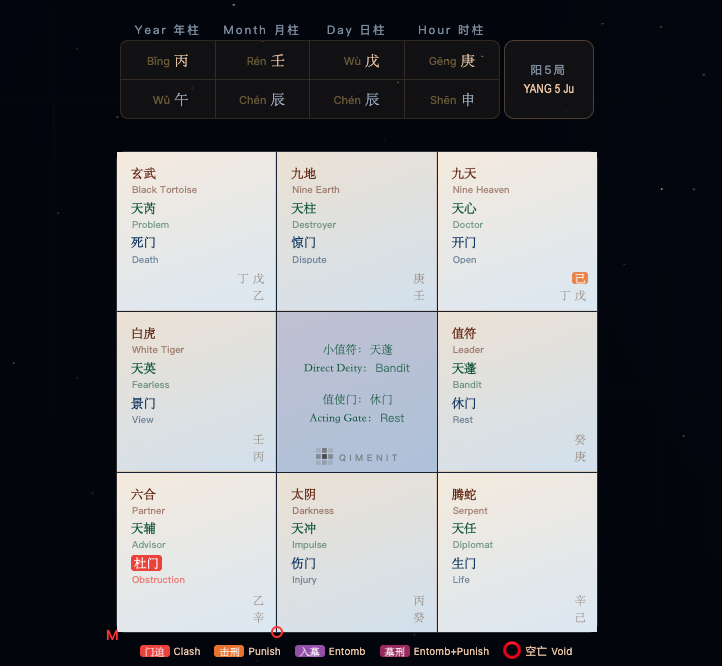
The analysis highlighted the pressure points first. Of five key factors, two were unfavorable, two were neutral, and the only favorable one was the role itself — the job was not the problem, his position inside it was. And the one opening sat neither with his boss nor in what the job paid, but in his own position.
“He has the ability, and he has the will to actively seek change. But he is held down by the boss directly above him, and what the job returns to him runs against his own state — effort and reward are out of proportion, and the internal drain is heavy.”
— from the analysis, uneditedThe risk section, written at the time, read: “Your efforts and ideas struggle to be recognized, your room to develop stays narrow, and prolonged strain in that state may unbalance you or force your exit.” He did not dispute the analysis. But he also did not act on it, and never quite treated it as an account of his own situation. Two months later, he left the company.
Back to what this section opened with: what it does not do. At no point did it tell him to resign, and it never named a date. An analysis that makes the decision for you is doing something it has no business doing. What it did was narrower, and more useful: it put in front of him where the pressure came from, which layer the problem sat in, and whose hands the leverage was in. The judgment stayed his. He understood all of that back in April. Understanding a situation is one thing; taking it seriously enough to act while there is still room to do so is another. That gap is where the two months went. Read the full case →
What You Get
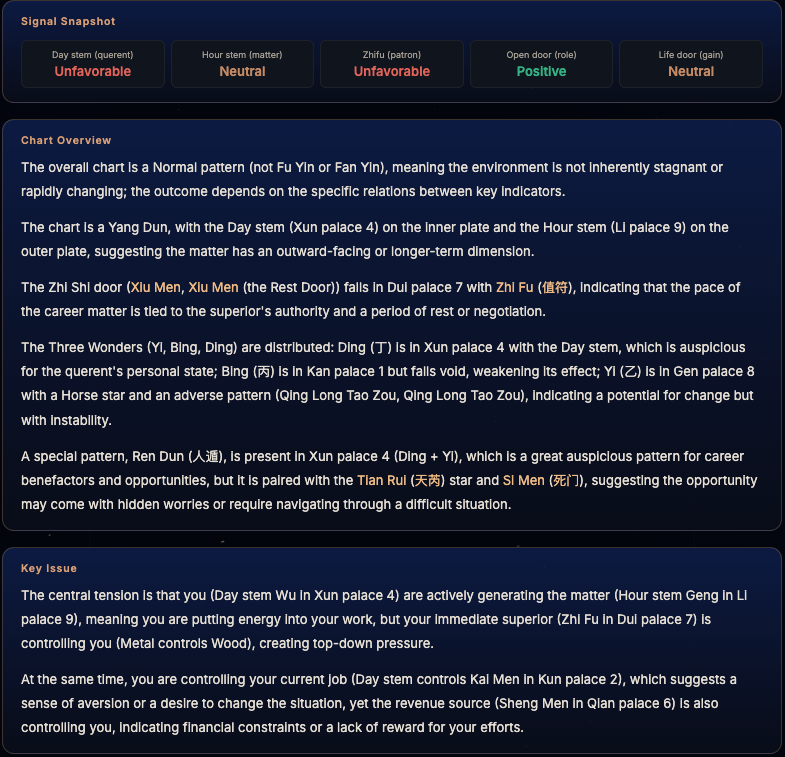
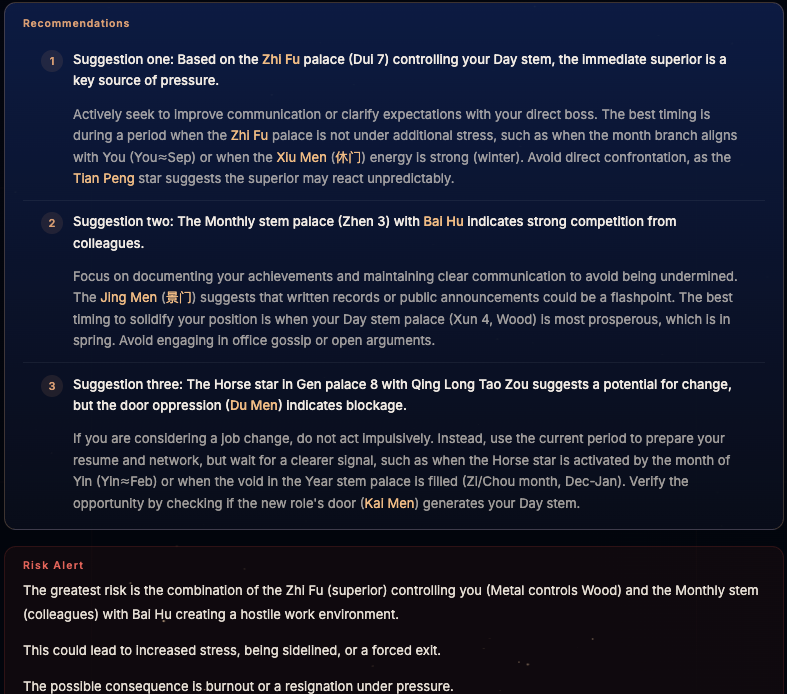
A full analysis comes in three parts. First, the core direction — which way the situation leans, stated up front rather than buried at the end. Then the key factors, across Timing, Terrain, People and Winds, each set out in plain language. Then what to do with it: which directions are worth pursuing, which conditions are worth confirming first, and what to keep an eye on as you move. The screenshots below are from a real analysis, not a mock-up.
What QimenIt Is Good For
A good fit: one specific matter in your life right now where you need a clearer view. One matter per chart — that is the only rule. These come up most; each link shows how that kind of question is analyzed:
Not a good fit:
- Asking for a guarantee. “Will this definitely work out?” The analysis can show you which way things lean and where the risk sits. It cannot take the uncertainty out for you — the outcome still depends on what you do, and on what happens next.
- Standing in for professional judgment. You can ask about health or legal matters, and the analysis will tell you which way the situation currently tilts. But it does not diagnose, prescribe, or rule on anything. Medical questions belong with your doctor, legal ones with your lawyer.
- Prying into someone’s private life, or trying to work them. “How do I get them to come back to me?” “How do I outmaneuver a competitor?” Questions like these have stopped being about grounding your own decision.
- Matters too small to warrant it, and asking the same thing over and over. You don’t need a chart to pick dinner. Ask a question once — casting it again at a different hour will not make the answer any truer.
A simple test: before you cast, ask yourself whether the matter is specific, whether it genuinely involves you, and whether the answer would change what you do next. If all three hold, it is worth asking. How to ask a good question →
If You Are Weighing Several Options
Beyond reading a single direction, QimenIt can also compare options against each other. Under the Decision category, choose Compare options, and you can enter two to four options you are considering. The analysis then compares how each one sits in the current situation, rather than handing back one broad direction. For example: stay at the current company, take the new offer, hold off for six months.
A Few Things You'll Want Cleared Up First
How is this different from traditional fortune-telling?
Traditional practice usually concerns itself with long arcs and life themes. Qimen Dunjia can be used to examine a whole life, and we won’t pretend otherwise. The difference is emphasis: QimenIt works on the matter in front of you now. It uses Qimen Dunjia to examine the situation at this moment — what conditions you have, which forces are working on the outcome, and which direction merits more weight. So what you get here is decision support for one specific matter, not an overview of your life.
Do I need to know anything about Qimen Dunjia?
No. You only choose the question you want analyzed. The chart, the palaces and the traditional symbols are handled by the system and turned into something you can read directly. If you want to understand the method underneath it, the resources section covers it — but nothing there is required to ask.
Will it make the decision for me?
No. QimenIt will never tell you what you must choose. What it gives you is an analysis of the current situation, the openings and limits that may be present, and the factors worth watching as you act. It is closer to a weather report than a command, and the decision stays yours throughout. Why we hold that line →
How do I ask a better question?
You don’t have to word the question yourself — the category and the focus are both offered on the page. Two other things do most of the work. First, which single matter you have fixed in mind: at the moment the chart is cast, holding “should I take this job” rather than a vague “how is my career going” leads you to choose a different focus. Second, one matter at a time — bundle three worries into one chart and none of them comes out clearly. How to ask a good question →
How can the moment I ask say anything about my matter?
That is the core premise of Qimen Dunjia: the moment a question becomes urgent enough to ask carries the state of the situation itself. The chart is a structured snapshot of that moment, read through rules refined over centuries. Whether that premise convinces you is a fair question — here is the honest version of the argument, doubts included.
What’s the difference between the free analysis and the full one?
Once you register, you receive two basic analyses free every day: the core direction, a read on what is supporting and resisting the matter, and an overview of the situation. That is enough to understand the direction the method indicates. The full analysis is paid, and it is not part of the two daily free ones — on top of the basic analysis it adds each key factor set out in turn, what to do with it, and the risks to watch. Pricing is on the pricing page; asking itself requires no subscription.
Is this a turning point, or a hole?
Move now, or hold a little longer?
This person — can they be trusted?
When a decision cannot be settled by comparing information, it is worth looking at the situation from somewhere else. Choose the matter you have been turning over, and see what a Qimen Dunjia analysis makes of it.