Once an offer is in hand, the question is no longer “will they hire me,” it is “should I move.” Qimen reads a move through one pivot: the movement star, Horse Star. When Horse Star is active and your Day Stem controls the Open Door (日干克开门), the chart favours making the jump. When the Open Door generates your Day Stem but no Horse Star shows, the honest reading is the opposite: your present seat suits you, and moving is likely to be regretted, so hold. When the Open Door controls your Day Stem, the change tends to be forced on you rather than chosen. Whether the pay and prospects after the move actually beat what you have now is read from Life Door. The verdict is take it, hold, or decline, with the reasons.
Before the rules, one real chart. April 2026: a man who had just started a new job asked how the road ahead looked. The reading named it plainly — capable, willing, “held down by the boss directly above him, effort and reward out of proportion” — and located his single greatest turning point in his own palace. He didn't act on it. Two months later he resigned. Read the full case →
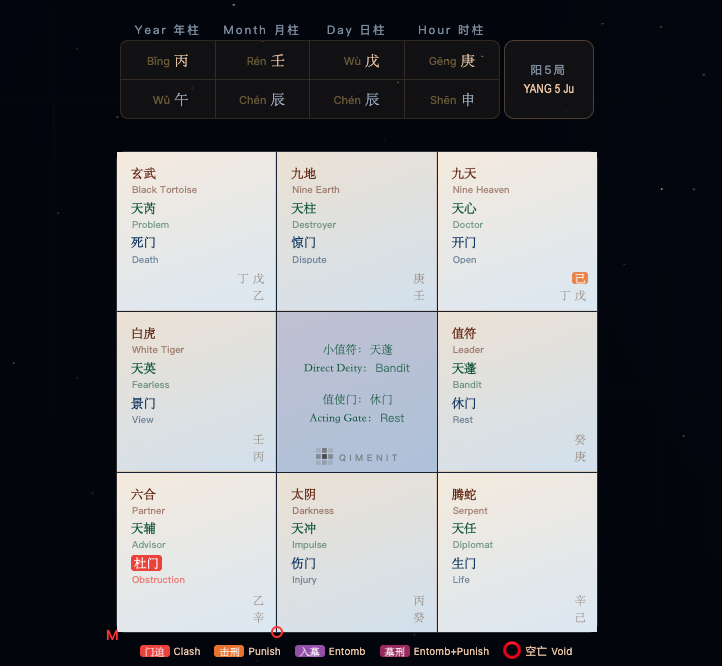
What Does a Job-Offer Chart Actually Predict?
Begin with what the chart cannot do. It will not guarantee the job works out. What it will show you are two things you genuinely care about: whether the role suits you, and whether the moment is ripe or you'd do better to hold. Both are read from a single chart, from how the palaces generate or control one another. And in Qimen, a single door carries the whole question of the job:
The Open Door stands for the job. When one of the Three Wonders sits with it, the job reads as a salaried or official one rather than something you build yourself.
That line anchors the whole read. The Open Door is the job. Healthy, and touched by a Wonder (Three Wonders: Yi · Bing · Ding)? The role is solid and above-board. Everything below is the same question asked a few different ways. How does that door treat you?
Which Palaces Decide a Job-Offer Question?
Because this is a move, not a job hunt, the symbols we read are the ones that govern change: the job, you, the movement star, the pay after moving, and the pace of the change. The same movement grammar drives two sibling questions: quitting to start a business when the destination is your own venture, and relocating to another city when the move is geographic.
| Symbol | What it stands for here |
|---|---|
| 开门Open Door | The job itself, both the one you hold and the one on offer. It reads as salaried or official employment. |
| 日干Day Stem | You: your position and strength in the matter. |
| 驿马Horse Star | The movement signal: whether a change is even in the cards. No Horse Star, no real reason to move. |
| 生门Life Door | The gain after moving: pay, growth, prospects at the new post. |
| 值使门Chief Door | The pace and execution of the change: how smoothly it actually plays out. |
Which Patterns Decide the Verdict?
The pivot is Horse Star; after that, the direction between you and the job. These are the move-signals we read first, and we read them in this order:
| Pattern in the chart | What it means for the move |
|---|---|
| Day Stem controls Open Door + Horse Star active | ✓✓ Move on your own terms (宜主动跳): the change is yours to lead |
| Life Door generates your Day Stem | ✓ Pay and prospects after the move beat what you have now (变动后优于当前) |
| Heaven plate controls Earth plate (guest over host) | ✓ Going is favoured (去好): the move works in your favour |
| Open Door generates your Day Stem + no Horse Star | ✕ Don't move lightly: the present post already suits you; jumping tends to be regretted |
| Open Door controls your Day Stem + Horse Star | ✕ A change forced on you (被动变动): a layoff or reassignment, not a choice |
| Either palace on Void, or your Day Stem in Repeating Yin | ✕ Going comes to nothing (去了白去): the move doesn't take, or the offer thins out |
Notice the trap most people fall into. A door that generates your Day Stem feels like a green light, yet with no Horse Star it reads the other way: your current post already fits you, so the move is the thing to hold off on. The movement star decides whether to move at all; the direction between you and the door decides whether that move is yours to lead or forced upon you. Read Horse Star first, then the generation and control.
Take It or Walk Away: How Do the Signals Compare?
Now put it all on one page. Same factor, two readings: green sends you one way, red the other.
| Chart factor | ✓ Points to “move” | ✕ Points to “stay” |
|---|---|---|
| Movement: Horse Star | Horse Star active: there's a real “move” signal in the chart | No Horse Star: nothing is actually pushing a change; the present post is settled |
| You vs the job: Day Stem / Open Door | Day Stem controls Open Door: the move is yours to lead | Open Door controls Day Stem: a change forced on you (layoff, reassignment) |
| Gain after moving: Life Door | Life Door generates your Day Stem: better pay and prospects than now | Life Door on Void: the pay and prospects thin out |
| Is going worth it: Heaven Plate / Earth Plate | Heaven plate controls Earth plate (guest over host): going is favoured | Earth plate controls Heaven, or a palace on Void: going comes to nothing |
- Horse Star active + Day Stem controls Open Door: a move you get to lead
- Life Door generates your Day Stem: the new post pays and grows better than now
- Heaven plate controls Earth (guest over host): going is favoured
- Open Door generates you but no Horse Star: the stable job already fits; don't jump
- Open Door controls your Day Stem: the change would be forced, not chosen
- Life Door or a palace on Void: the new pay thins out, or the move doesn't take
Say Horse Star is active and the move is yours to lead, but Life Door is thin. That isn't a “stay.” We would read it as the move is right, but the pay isn't settled. Pin the compensation down before you sign. That is exactly the nuance a flat yes-or-no cannot carry.
What Happens When the Verdict Is “Hold”?
Not every reading lands on “take it” or “walk away.” The third verdict is hold (宜缓): the offer isn't wrong, the conditions around it simply aren't ripe. The chart shows where the gap sits, such as an emptiness (Void) on the pay that only settles once its branch is filled, which tells you what to wait for and what to secure in the meantime. That is a verdict in its own right, and it is a different instruction from stop (宜止), where the road ahead is genuinely poor and stepping back is the prudent move. Reading the two as one is how people either decline a workable offer or accept a hollow one.
Qimen reads this offer. If the real question is bigger, whether this whole career path even fits your life, that's a job for BaZi (八字), your birth chart. Qimen picks the move. BaZi reads the direction.
Frequently Asked Questions
Can Qimen really tell me whether to take a job?
It maps the conditions surrounding the move, closer to a weather report than a verdict. Qimen shows how favourable the timing, the role and the people around it are at present: who is receptive, where your leverage lies, and what friction may be hidden. The decision remains yours; you simply make it with the forecast in hand.
The offer looks great and Open Door generates my Day Stem. Why would you still say stay?
Because a job move hinges on Horse Star, the movement star. Open Door generating your Day Stem means the seat suits you, but with no Horse Star in the chart we read that as not to move lightly: the fit you already have is worth keeping, and jumping tends to end in regret. The genuine “go” signal is Horse Star active together with your Day Stem controlling Open Door (日干克开门). A good chart is not the same as a chart that says move.
The chart looks bad. Does that mean I should never take the job?
A poor chart is a verdict on this offer, not on your career. It also matters which poor verdict it is. Hold (宜缓) means the conditions around this offer aren't ripe yet; the chart shows where the gap sits, and the usual move is to secure the missing terms before answering. Stop (宜止) means the road ahead of this particular offer is poor, and declining it is the prudent call. Your career is a separate question, and a much longer one.
Wondering why a traditional system is being used to weigh a decision at all? That question is taken up separately in divination for decision making, which covers what each of these systems is suited to and where the category has to stop.
If this is the decision on your table tonight, choose Decision-making · Act or hold and cast a free chart. The verdict comes back as go, wait, or stop — with the reasons, each signal explained in plain language. See what a full reading looks like →
Cast a Free Chart →